
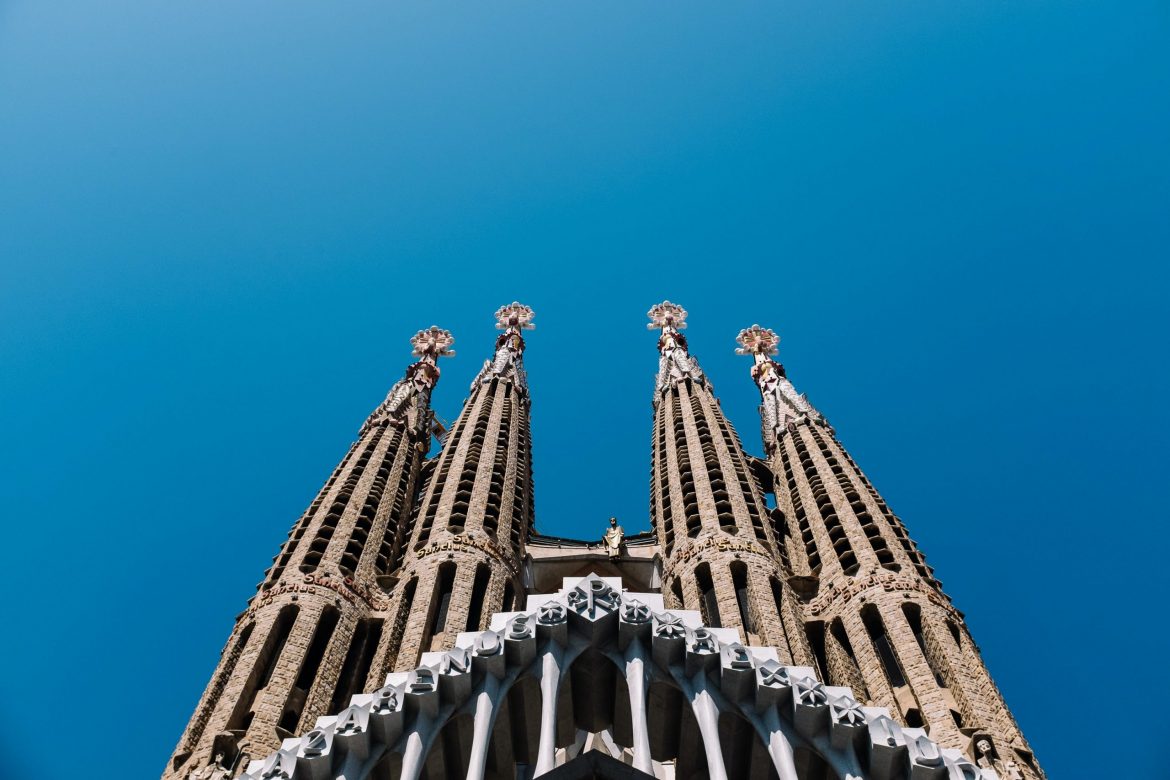
The expiatory temple of the Sagrada Familia, whose construction began in 1882, is today one of the signs of identity of Barcelona, recognized worldwide and visited by millions of people. The part built by Gaudí was declared a World Heritage Site by UNESCO in 2005. The Construction Board hopes to complete the work in 2026, when the centenary of Gaudí’s death is commemorated.
- It is being built with new computer-aided technologies
In the 20th century all those colossal stone sculptures were carved by hand, luckily modern technology has helped speed up the process. Today, builders use computer-aided designs and numerically controlled milling machines to shape stone. The creation of another ten towers (each of which represents an important figure or biblical element) is the next technological challenge.

- It will be the tallest church in the world
At 172 meters high, Gaudí’s masterpiece will unseat Ulm’s main church as the tallest ecclesiastical building in the world. The designs of this Spanish master of architecture are tall and its 18 towers will represent the Apostles, the Evangelists, the Virgin Mary and Jesus.

- It will have several organs that can be played by a single person
Listening to a performance at the Sagrada Familia is an unforgettable sight. The 1,492 pipes of its organ emit an amazing sound, but due to the acoustic challenges posed by its architecture, just one is not enough; For this, other organs will be installed that will make a total of 8,000 pipes throughout the church. The most curious thing is that a single person can touch them simultaneously.

- Gaudí is buried in La Sagrada Familia
You cannot visit the Sagrada Familia without going to see one of the most famous Catalan characters and that is that Gaudí is buried in his own architectural legacy. After his life was cut short in a tram accident, he was buried in this great work. You will find his tomb in the chapel dedicated to the Virgen del Carmen.

- The stone for its construction travels from different parts of the world
The musician and architect Antoni Gaudí began using the stone from the Montjuic quarries, stone that is framed between the mountain and the sea. At the time, up to 228 different quarries were exploited, which caused them to close in the year 27. In order to continue with its construction, shipments of stone are brought from quarries in Scotland, Cantabria, Galicia, France and England. The masses of stone that cross Europe weigh more than 400 tons, the equivalent of more than 40 buses together that have to travel to Barcelona, and of which 100% is used.

- Antoni Gaudí was not its first architect
The initial commission took shape at the hands of the architect Francisco del Villar, who designed a church according to the time, but resigned after a year of construction. It was with his resignation the following year that Gaudí took over and took a more radical turn (above all due to his peculiar application of geometry, influenced by nature). Gaudí dedicated 43 years to the project, the last 12 years exclusively. He inherited a neo-Gothic project from Villar, and decided to change its dimension and make a cleaner space that allows light to enter.


Comments are closed.